HISTORY, SOCIETY, AND INSTITUTIONS: THE ROLE OF COLLECTIVE MEMORY IN THE EMERGENCE AND EVOLUTION OF SOCIETAL LOGICS
WILLIAM OCASIO MICHAEL MAUSKAPF Northwestern University
CHRISTOPHER W. J. STEELE University of Alberta
We examine the role of history in organization studies by theorizing how collective memory shapes societal institutions and the logics that govern them. We propose that, rather than transhistorical ideal types, societal logics are historically constituted cultural structures generated through the collective memory of historical events. We then develop a theoretical model to explain how the representation, storage, and retrieval of collective memory lead to the emergence of societal logics. In turn, societal logics shape memory making and the reproduction and reconstruction of history itsel. To illustrate our theory, we discuss the rise of the corporate logic in the United States. We identify two sources of discontinuity that can disrupt this memory-making process and create notable disjunctures in the evolution of societal logics. We conclude by discussing how changes in collective memory and the historical trajectory of societal logics shape organizational forms and practices.
History plays a critically important but often underspecified role in the lives of institutions, organizations, and their members. Since at least the 1990s, scholars have advocated that theories of organization take history more seriously (Clark & Rowlinson, 2004; Keiser, 1994; Zald, 1993). Yet a theoretical and methodological divide persists between those who study organizations and those who study history. According to historian and political scientist William Sewell, Jr.’s Logics of History, there is a logical explanation for this condition:
While historians do not think of themselves as theorists, they know something social scientists do not: how to think about the temporalities of social life. On the other hand, while social scientists’ treatments of temporality are usually clumsy, their theoretical sophistication and penchant for structural accounts of social life could offer much to historians (Sewell, 2005: back cover).
Is there any hope of bridging these worlds to provide a dynamic integration of structural and historical accounts of organizational life?
Our answer to this question is an unequivocal yes. Although many organizational theories are implicitly ahistorical or reduce history to a temporal variable, some contain the raw materials to acquire an explicitly historical lens (Kipping & Usdiken, 2014; Rowlinson, Hassard, & Decker, 2014). Institutional theory seems particularly well suited to this task (Suddaby, Foster, & Mills, 2014). Yet while research across the social sciences may recognize that history operates through institutions to constitute the social world (Mahoney & Thelen, 2007; Thelen, 1999), the details of this argument and its consequences remain underdeveloped (Kipping & Üsdiken, 2014).
We further the integration of history and organization studies by theorizing how the process of collective memory making shapes our understanding of historical events and societal institutions. To accomplish this, we employ and extend the institutional logics perspective (Friedland & Alford, 199l; Thornton, Ocasio, & Lounsbury, 2012), which contends that organizations and their activities are embedded in historically situated webs of meaning and significance. These webs are structured by institutional logics— sets of organizing principles that provide actors with vocabularies of motive and practice. Although scholars have explored the historical contingencies of field-level logics and their implications for organizational practices and forms (Haveman & Rao, 1997; Scott, Ruef, Mendel, & Caronna, 2000; Thornton & Ocasio, 1999), they have largely ignored the historicity of societal logics. While the historical provenance of societal logics is widely acknowledged, they are mostly theorized as Weberian ideal types—that is, transhistorical generalizations of abstract principles (Thornton et al., 2012). For example, when institutional scholars study the overarching principles that structure our understanding of “the market” or “the corporation,” they rarely explore how these societal logics emerge or change over time (cf. Lipartito & Sicilia, 2004; Polanyi, 1944). Here we acknowledge not only that societal logics have “specific historical limits” (Friedland & Alford, 1991: 249) but that they also provide a new theory detailing history’s role in the generation, reproduction, and transformation of societal logics.
In contrast to the ideal-typical approach, we propose that societal logics are historically constituted cultural structures generated through collective memory making. Field-level logics tend to emerge from the shared experiences of interconnected groups of actors, but the origin of societal logics has not been adequately theorized. In large, complex societies, individuals are often too widely dispersed, and their local contexts too disparate, to share universal experiences (Durkheim, 1964). Absent the common ground of shared experience, we propose that collective memory supplies individuals and organizations with the information and schemas required to effectively navigate society and social life. Collective memory, as a system of values, identities, and practices shaping the commemoration and (re)interpretation of historical events (Schwartz, 2005; Schwartz & Kim, 2002), serves a constitutive role in the emergence and evolution of societal logics. In turn, societal logics provide a historical lens through which memory and history are recursively shaped, reproduced, and reconstructed.
After unpacking this argument and situating it within existing research on institutional logics and collective memory, we divide the remainder of the article into three parts. First, we develop a new process model that posits societal logics as emerging from collective memory making of historical events. We begin by discussing the representation and documentation of localized occurrences. Then we examine how these assorted documents are arranged and stored within archives. Patterns in the retrieval of documents from these archives give rise to historical events—episodes of societal significance that are similarly identified, if differently interpreted, by the dispersed actors in society. As the memory of historical events develops and is reinforced (or reinterpreted), metanarratives emerge to help impose order on the past and present. When these metanarratives converge and stabilize, they generate societal logics, which, in turn, shape the memory-making process.
Second, we provide an illustration of our model with reference to the emergence and evolution of the corporate logic in the United States, shaped by the collective memory making of historical events. In the process, we contrast our historically embedded explanation of the corporate logic with the prevailing ideal-typical approach.
Third, we propose and discuss several sources of historical discontinuity in collective memory making. We highlight two sources of discontinuity in particular:(1) the confluence of events across institutional fields (e.g., series of events that come to be seen as watershed moments or as phase transitions in the evolution of society) and (2) changes in the communicative infrastructure (e.g., the complex of technologies and practices through which collective memory making takes place). We conclude the article by discussing how our model might inspire a more historically informed approach to institutional logics and proposing implications for the study of organizations and organizational theory more broadly.
HISTORY, INSTITUTIONAL LOGICS, AND COLLECTIVE MEMORY
History, which for our purposes refers both to the accumulation of past events and to the documents, narratives, and memories attached to them, has enjoyed a renaissance in organizational studies since the linguistic and cultural turns of the 1970s and 1980s. Nevertheless, most of our discipline’s theories remain relatively ahistorical (Kipping & Üsdiken, 2014). This state of affairs reflects a more general epistemological divide between social science and history (Rowlinson et al., 2014). In the words of Hayden White (2010: 192), historians “deal in ‘concrete’ reality rather than ‘abstractions’; their interest is in discovering the true story behind the events reported in the documents and telling that story well,” rather than in generating universal claims. White (1973) nonetheless argued that maintaining a strict separation between the “factual” sciences and interpretive history is unnecessary and ultimately unproductive. A flurry of recent research in organization theory has begun to take White’s credo seriously (Booth & Rowlinson, 2006; Bucheli & Wadhwani, 2014; Greenwood & Bernardi, 2014; Rowlinson et al., 2014), and we follow in this trα- dition as we develop a more historical account of institutional logics and their consequences.
The institutional logics perspective maintains that social life is organized into distinctive arenas or domains of activity that are characterized by particular logics or principles of organization (Friedland & Alford, 1991). Logics provide actors with a more or less cohesive set of assumptions, rules, and beliefs to help them make sense of the world, orient themselves toward others, and account for their behavior. Logics may sometimes be followed automatically but are frequently subject to mindful reflection and mobilization (Thornton et al., 2012). They provide people with cultural resources that can be used to shape collective identities and practices (Pouthier, Steele, & Ocasio, 2013; Rao, Monin, & Durand, 2003), to establish and legitimate organizational cultures (Battilanα & Dorado, 2010; Kraatz, 2009), and to pursue or resist organizational change (Gawer & Phillips, 2013; Lok, 2010). Indeed, individuals may have different relationships with available logics, identifying with some and making use of them to signal affiliations or solve problems while actively resisting others (Creed, DeJordy, & Lok, 2010; Kellogg, 2011; Lok, 2010). Similarly, at the organizational level, logics provide resources for shared sensemaking, symbolic management, and the crafting of identity (Glynn, 2000; Greenwood, Raynard, Kodeih, Micelotta, & Lounsbury, 2011; Suddaby & Greenwood, 2005). Dominant logics constrain the organizational forms that are considered legitimate within a given domain (Haveman & Rao, 1997), while other available logics provide alternative templates that can be used to develop and legitimate new forms and innovations (Tracey. Phillips, & Jarvis, 2011), ultimately shaping organi. zational ecologies.
Societal Logics As Historical Formations
Much of the research on logics focuses on temporal shifts in dominant logics and their consequences for particular institutional fields, such as higher education publishing (Thornton & Ocasio, 1999), French cuisine (Rao et al., 2003), and the U.S. pharmaceutical industry (Goodrick & Reay, 2011). Shifts in field-level logics can lead to outcomes at other levels of analysis as well, including the evolution of organizational forms (Haveman & Rao, 1997) and the possibility of intraorganizational conflict (Dunn & Jones, 2010; Murray, 2010). This work has tended to view history primarily as a scope condition or forcing variable, rendering local institutions and organizations historically contingent (Thornton & Ocasio, 1999). We suggest that a more complete integration of history and the logics perspective requires engagement with the historicity of logics, particularly the far-reaching societal logics within which field logics are nested. Historicizing these logics and their configurations across institutional orders can enhance our ability to study and understand the historical trajectory of institutions and their organizational- and individuallevel effects (Hatch & Zilber, 2012; Schwartz & Kim, 2002).
As already discussed, societal logics serve as the organizing principles for distinct domains of social activity. In extant theoretical and empirical research, scholars have identified seven distinct societal logics, although there may be others. These include (Thornton et al., 2012) the family (defined by unconditional loyalty to blood relations and other family members), religion (the sacredness and profanity of certain activities, things, and actors), the state (democratic participation), the market (pursuit of profit and share price), professions (personal and certified expertise), community (trust and reciprocity), and the corporation (rationalized bureaucracy and the pursuit of market power).
Each of these societal logics is often conceptualized as a transhistorical ideal type that appears fixed over time. We argue instead that these logics are historically constituted through collective memory. Whereas field-level logics may be grounded in the shared experiences and histories of local actors, societal logics address a broader and more dispersed set of individuals who are unlikely to share many experiences. This has two key implications. First, we argue that the power of societal logics rests on the creation of experiences that can be shared by nonparticipants. Collective memory supplies people with the mediated “experience” needed to navigate different institutional orders and the logics that organize them.
Second, societal logics operate differently than field-level logics as a result of their unique form and content. Like field-level logics, societal logics shape cognition, behavior, and organization within a specific jurisdiction (e.g., within “the family”). In addition, however, we propose that societal logics provide foundational principles that can be used in the creation, maintenance, and disruption of more situated field-level logics. They allow reflective actors to evaluate more localized logics through the invocation of broad, well-recognized principles that cut across fields and permeate society. Thus, societal logics influence organizational and individual cognition and action across a wide range of fields. Moreover, they provide widely understood principles that can be used to guide and justify behavior whenever field-level logics break down. The influence of societal logics on organizations and individuals is often filtered through field-level logics; however, societal logics also have a direct effect in times of reflection and disruption. In both respects, their impact cuts across fields and influences broad swaths of social life at any given time. Thus, understanding how societal logics are constituted through collective memory aids our understanding of how individual-, organizational-, and field-level phenomena vary across historical periods.
retrieval and reinterpretation. For the sake of clarity, we refer to the production, arrangement, and consumption of such traces as collective memory making, a process that produces the content of collective memory and shapes the configuration of societal logics.
Of course, the means by which collective memories are made is also a topic of debate in history, sociology, and management. For most scholars collective memory refers to group commemorations of the past, but others use the term interchangeably (with collected memory) to refer to the aggregation of individual memories (Olick, 1999). While it may be true that only individuals possess the capacity to contemplate the past (Gedi & Elam, l996), this does not mean that beliefs originate in the individual or can be explained on the basis of personal or immediately shared experiences alone. Much of what we remember reflects our indirect experience as members of particular groups, institutions, or “mnemonic communities” (Halbwachs, 1992; Zerubavel, 1996). Thus, collective memory making is not just a cognitive process but a social one, generated through communication and dynamic patterns of interaction (Casey & Olivera, 20ll; Cuc, Ozuru, Manier, & Hirst, 2006) and stored in material artifacts and collective consciousness (Fine & Beim, 2007). Rather than a purely cognitive model, our version of collective memory is embodied in symbolic and material documents (e.g., language and linguistic categories). These documents are then catalogued, stored, and sometimes retrieved to reconstruct the past and situate the present.
Collective Memory
Indebted to the work of Émile Durkheim and his student Maurice Halbwachs, contemporary collective memory research is at once rich in conceptual depth and inconsistent in definitional clarity (Olick, Vinitzky-Seroussi, & Levy, 2011). Most sociologists frame collective memory as a process that is defined through the act of remembrance or commemoration (Boje, 2008), but others entertain the possibility that memory is a thing that can be stored, retrieved, and forgotten (Fine & Beim, 2007; Walsh & Ungson, 1991). Here we follow sociologist and memory scholar Jeffrey Olick, who defines collective memory as “both the medium and the outcome of social configurations” (2007: 118). While memory may be activated through the act of commemoration, we suggest that certain sociomaterial traces of memory (e.g., documents) remain stored in archives, where they serve as important touchstones for future
Almost inevitably, collective memory is rooted not only in the desire to document past events but also in the desire to make sense of the present through the interpretation and commemoration of the past (Casey & Olivera, 201l; Schwartz, 1996, 2000), both of which are critical aspects of “history.” Although collective memories may refer to real events—and be attached to real objects that serve as important touchstones for remembrance and (re)interpretation—they are multiple, dynamic, and under continuous revision (Boje, 2008). Different interpretations of the past vie for attention to enter and potentially alter prevailing collective memories, and the outcome of such meaning tournaments has concrete social and organizational consequences (e.g., Anteby & Molnár, 2012; Nissley & Casey, 2002). Research by psychologist Barry Schwartz and others highlights this point: the past is continually reinterpreted to fit the changing landscape of the present and, we would add, to shape the social construction of the future (Cook, 2007). Collective memory’s dual identity as a representation of the past and a tool for the remaking (or forgetting) of the past implies a contradiction of sorts, arising from its deeply reflexive and historical roots. Schwartz addresses this paradox vis-à-vis collective memory’s role as a model of and for society:
As a model of society, collective memory reflects past events in terms of the needs, interests, fears, and aspirations of the present. As a model for society, collective memory performs two functions: it embodies a template that organizes and animates behavior and a frame within which people locate and find meaning for the present experience. Collective memory affects social reality by reflecting, shaping, and framing it. … The distinction between memory as a model of and a model for social reality is an analytic, not an empirical, one: both aspects are realized in every act of remembrance (2000: 301).
Just as society shapes our attention toward certain memories in the present, it also constrains our ability to reach into the past (Zerubavel, 1996) and imagine the future (Cook, 2007).
Our treatment of collective memory making as a social phenomenon involving the representation, storage, and retrieval of documents is informed by work on organizational memory as well. Walsh and Ungson’s (1991) foundational article in this journal presents organizational memory as a three-part sequential process. In their model, information is acquired from the external environment, retained across several retention facilities (e.g., including the minds of individuals; the culture, structure, practices, and ecology of the organization; and external archives), and then retrieved (automatically or consciously) to aid organizational members in the learning process. Although this conception fails to account for the experiential and historically specific nature of collective memory (Rowlinson, Booth, Clark, Delahaye, & Procter, 2010), it provides a helpful set of tools for analysis, much like the work on the manifestation and interpretation of organizational culture (Hatch, 1993).
A FRAMEWORK FOR UNDERSTANDING COLLECTIVE MEMORY MAKING
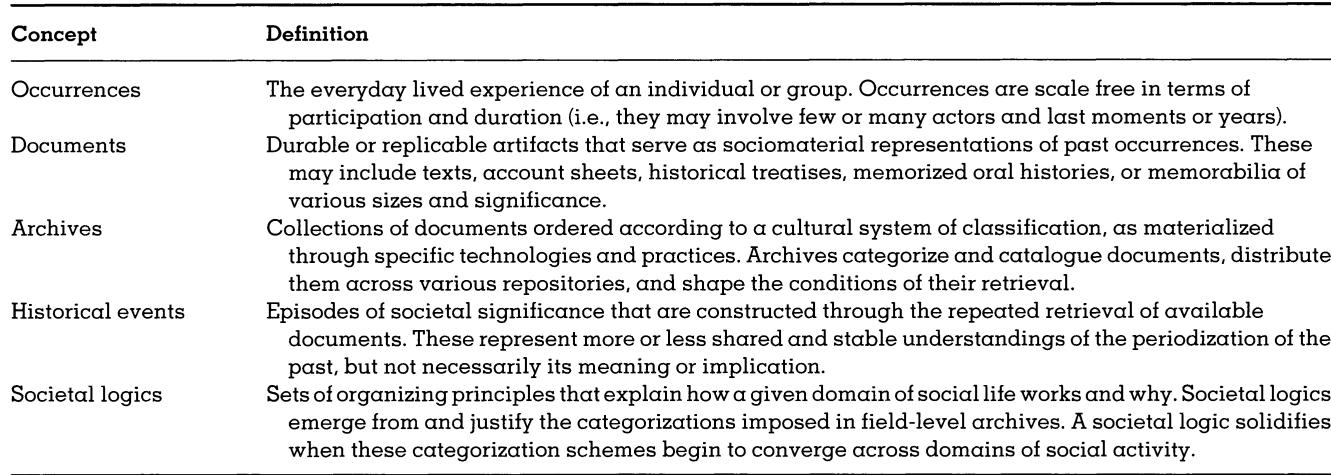
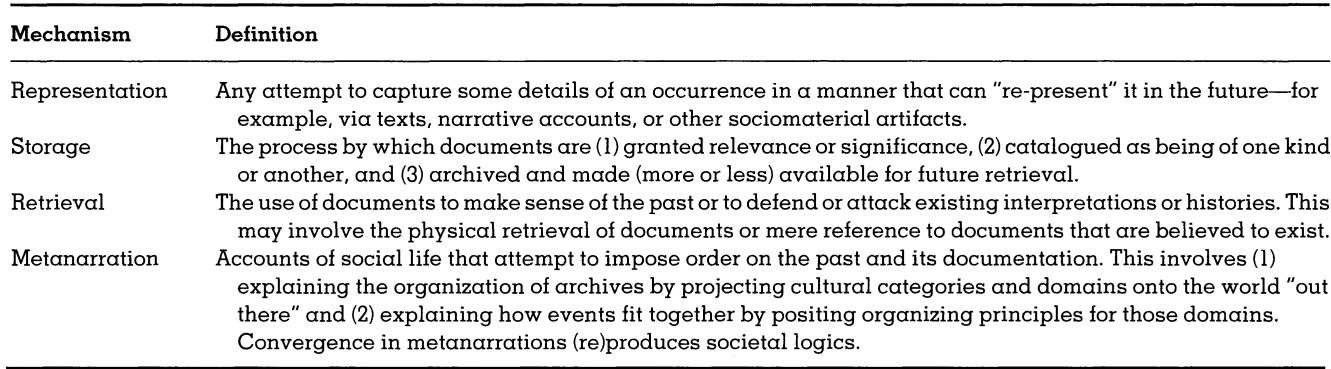
In this section we develop a model to show how societal logics emerge and evolve through the collective memory-making process. We present our framework in the form of a recursive process model, depicted in Figure l. For ease of understanding, we summarize definitions of key concepts and mechanisms in Table l and Table 2. Our primary objective here is to explain (1) how the historical accumulation of occurrences, events, and their affiliated documents constitute societal logics and (2) the means by which these logics shape the memory-making process. This approach is consistent with the “historical institutionalist” perspective in political science and sociology, where institutions are viewed as “outcomes of past events and interpretations of those events” (Suddaby et al., 2014: 111) that endogenously emerge from and gain meaning through a series of complex historical processes (Mahoney & Thelen; 2007; Schneiberg, 2007; Thelen, 1999). Furthermore, while our model focuses on the societal level, it also highlights the nested and cross-level nature of collective memory making, noting the critical roles of microlevel occurrences and localized structures in this process, as well the consequences of collective memory for changes in organizational behavior and culture (Schultz, 2012; Zilber, 2012).
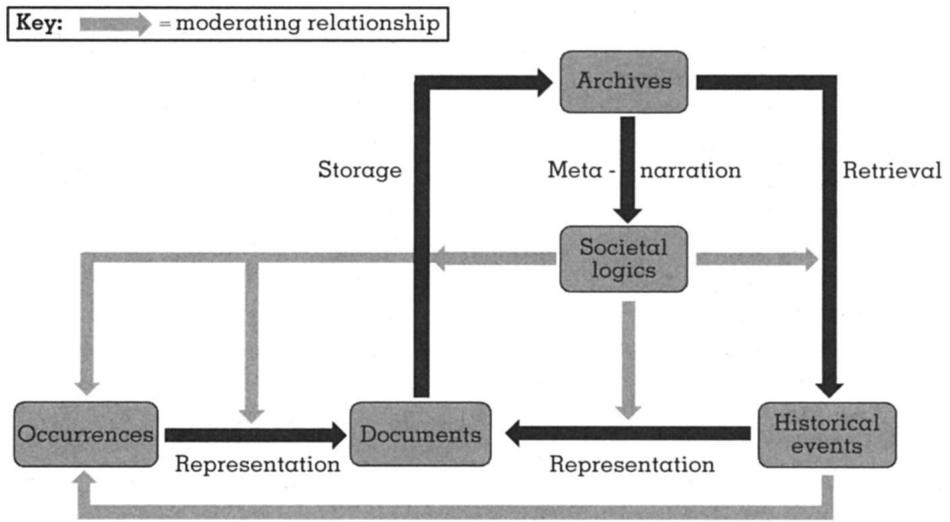
FIGURE 1 Collective Memory Making and the Historical Evolution of Societal Logics
TABLE 1 Core Concepts in the Historical Formation of Societal Logics
We acknowledge that analytical models of this sort often necessitate simplifications of dynamic phenomena. History is messy and nonlinear in a way that is difficult to capture within the confines of such a model, not least because memories vary widely in their interpretation and deployment, both over time and across peoples. Despite these challenges, however, we believe it is useful to present our argument in the form of a cyclical process model. Developing constructs with discrete interrelationships can be an effective heuristic to build and test theory in institutional analysis. We address how historical discontinuities and crisis can disrupt the evolutionary process suggested by our model toward the end of the article, but we begin by describing each step in this process.
Occurrences
We propose that the documents and stories from which history is constructed, reproduced, and challenged are generated through mundane occurrences or lived experiences. During the course of everyday life, individuals, groups, and organizations notice and bracket particular aspects of experience (whether their own or those of others), forging them into distinguishable episodes that can be attended to and analyzed separately (Weick, Sutcliffe, & Obstfeld, 2005). It is this bracketing and bounding that defines an occurrence, rather than the phenomenon itself: thus, a meal can be an occurrence, but so too can a strike, an election, a battle, or even a war. Once they have been cognitively bounded and labeled, occurrences provide “the common currency for communicational exchanges” (Chia, 2000: 517), making it possible for individuals and organizations to communicate and make sense of their experiences.
TABLE 2 Core Processes in the Historical Formation of Societal Logics
Consider a juridical meeting. In isolation, such a meeting is not distinct from the flow of individual experience; sensations of sound, heat, comfort, and discomfort continue, and everyday life goes on. Because individuals attend to and bracket particular aspects of the meeting—for example, the fact and the content of conversation—the meeting takes on a coherence of its own and becomes a shared experience. Moreover, this experience can be referenced and discussed by people who did not participate in the meeting at all but who share some common understanding of the episode’s boundaries and significance. Organizations play an important role here, both by structuring occurrences and by shaping individuals’ attention and interpretations (Daft & Weick, 1984; Ocasio, 1997; Weick & Roberts, 1993).
Note that occurrences exist outside of the collective memory “loop” represented in Figure l. In our model occurrences are an input to the collective memory-making process, since they are not subject to reinterpretation at the level of society, except insofar as they are later transformed into historical events. Only occurrences that are so transformed have sufficient significance to be commemorated and reinterpreted widely (Schwartz, 2005). In this sense occurrences influence collective memory making by serving as the essential raw material for documents and the definition of historical events.
Representation
To effectively enter collective memory, occurrences must first be meaningfully represented in some durable or replicable manner. The process of representation refers to the manifestation (Hatch, 1993) and transcription ofcontemporary occurrences into documents of one sort or another. It is often during this process that stories begin to emerge (Boje, 2008). Individuals work to connect occurrences, introduce causal connections and themes, and define actors and plots, helping them make sense of their pasts and orient themselves toward the future (Tsoukas, 2005; Weick et al., 2005). People may engage in this process alone, but representation is generally a collective endeavor whereby individuals propose tentative accounts to one another so that they can be confirmed, challenged, or elaborated(Weick etal., 2005;Zilber, 2007). Indeed, there is often a preemptive and editorial element to representation, with authors guided toward representations that are likely to be well-received and easily understood. Thus, the process ofrepresentation is forward looking, even as it concerns itself with the past.
Some representation processes are largely routine affairs whereby occurrences are documented as part of the work at hand, as in the case of administrative documents (Garfinkel, 1967; Wenger, 1998) or diaries. Other occurrences, however, arerepresented because they captured the attention of outside audiences (Hilgartner & Bosk, 1988; Hoffman & Ocasio, 2001). There are various reasons why an occurrence might attract widespread attention. Prior research suggests that an occurrence is more likely to be extensively represented and stored if it is promoted by a dominant narrator or editor, if it appears to connect with central societalstrains or tensions, orifitcan be easily linked to an existing category of comparable events (Cuc et al., 2006; Fine, 1997, 2007). Alternatively, an occurrence might attract attention because it resonates with a large audience of nonparticipants or because it seems unexpected or strange, demanding some response or reaction from those who hear about it (Hoffman & Ocasio, 2001; Schudson, 1989).
Documents
In our model the concept of documents is intended to capture the primary role of collective objects in the memory-making process (Fine & Beim, 2007). Following research in documentary and information sciences (Buckland, 199l; Lund, 2009; Olsen, Lund, Ellingsen, & Hartvigsen, 2012), we define a document as “any concrete or symbolic indication, preserved or recorded, for reconstructing or proving a phenomenon,” such as a past occurrence (Briet, 2006/195l, as translated by Buckland, 1991: 354). This definition encompasses a broad array of artifacts, including texts, audio and video recordings, formal oral accounts, memorabilia, and memorials, among others. Across these forms, multiple documents will often provide conflicting accounts of the past, thus providing a critical space and resource for collective memory making (and remaking). Note that documents are generated not only through the representation of contemporary occurrences but also through the representation (and reinterpretation) of historical events. Both processes produce new documents that enter collective memory, shaping our understandings of the past, present, and future.
Storage
While some scholars have emphasized the role of remembrance and commemoration in the constitution of collective memory (Schwartz, 2000, 2005), others have argued that storage plays an important role in its conservation and reproduction (Fine & Beim, 2007; Walsh & Ungson, 199l).From our perspective, memories may be activated through individual acts of remembrance, but documents shape, legitimate, and even trigger this process. Not all documents remain available for collective memory making, however; they must first be effectively stored.
The process of storage is threefold. First, storage involves retaining certain documents for future reference, thereby transforming localized representations into enduring resources for shared memory making. This may involve a process of formal publication or recognition, or it may be more informal, perhaps requiring only the click of a button depending on the technological and social context (e.g., the communicative infrastructure). Second, storage encompasses the cataloguing of documents—their assignment to some repository, their indexing, and their organization according to period or theme. Finally, storage entails the maintenance of documents with some degree of retrievability, although not all stored documents remain easily retrievable.
They may be lost, forgotten, or even destroyed, especially if they are not obviously connected to matters of practical or cultural significance. The dynamics of storage are contingent on a variety of factors, including the influence of professional gatekeepers (such as archivists and historians), prevailing interests (Wry, Cobb, & Aldrich, 2013), ideologies (Lukes, 2005) and logics (Thornton et al., 2012), and the rhetorical appeal of the representations in question (Schudson, 1989). These dynamics are the domain of the archives.
Archives
In essence, archives are collections of documents that have been organized according to some system of classification—a system that need not be explicit or particularly precise. Beyond this point, definitions of archives vary widely (Manoff, 2004; Zeitlyn, 2012). Some definitions focus on discrete collections of texts, with definite physical locations, whereas others are more abstract. For example, Foucault envisaged a general societal archive responsible for classifying and contextualizing all the statements made by its members. Rather than any one specific, concrete collection of documents, Foucault’s archive is a system of principles and technologies, carving out distinct domains of discourse with their own criteria for relevance, significance, and truth (Foucault, 2002).
We integrate these perspectives to define archives as collections of documents ordered according to some cultural system of classification. The classification structure of an archive (l) determines which documents are to be included in a given collection, (2) organizes them, (3) contextualizes them by relating them to each other, (4) stores them in one or more related repositories, and (5) permits and constrains their retrieval. Each of these interrelated processes is shaped by organizational practices, information technologies, and the politics enveloping archivists and their audiences (see, for example, Bowker, 2008; Saxer, 2010; Trace, 2002). This definition encompasses a variety of collection types, including public libraries and museums, private research collections, business archives, and Wikipedia’s digital database. It also suggests that archives can exist at very different levels of analysis. We can observe organizational archives (Trace, 2002), city archives (De Vivo, 2010), archives of colonial administrations (Stoler, 2002), and even national or international archives (Caswell, 2010). For example, the archive of civil law in the United States is distributed across a large number of organizations. Taken as a whole, this archive determines which types of documents are relevant for establishing legal precedent and which are not, which documents should be taken into account in legal argumentation and which should not, which legal documents are relevant to specific questions of law and which are not, and, ultimately, which documents are to be incorporated into our legal memory and in what manner.
Our definition is consistent with recent work in anthropology (Zeitlyn, 2012), the history of science (Bowker, 2008), and the archival sciences, where the political and cultural qualities of archives are receiving increasing attention (De Vivo, 2010; Schwartz & Cook, 2002; Stoler, 2002). Critically, it also foregrounds the cultural and political dynamics by which documents are contextualized and interrelated, emphasizing that archives are not neutral repositories for storage. Operating as a whole, archives influence collective memory making by shaping the dynamics of storage, categorization, and retrieval. In terms of storage, archives influence the production of collective memory by determining which documents serve as the raw materials for memory making. As professional archivists, historians, and other gatekeepers decide which documents are of sufficient importance to store, they create the conditions for both collective remembering and forgetting (Bowker, 2008; Schwartz & Cook, 2002). Archives also determine where and how selected documents are stored. This affects not only the relative durability and security of documents but also the possibilities for their retrieval, making certain documents available to the general public and others available only to carefully vetted professional historians or state officials. Finally, archives structure the process of retrieval by creating new relationships of relevance or irrelevance (or agreement and disagreement) between documents. The very organization of the archive, in other words, provides an interpretative context for those intending to retrieve a given document and remember an occurrence or event (Schwartz& Cook, 2002).
Retrieval
become archived within collective memory. Nevertheless, we know that memories become consequential through acts of remembrance (what others have called “re-presentation”), which shape individuals’ post hoc understandings of occurrences and influence future actions (e.g., Schwartz & Kim, 2002). We argue that this begins with the retrieval process, which encompasses the discovery, recollection, and reinterpretation of archived documents, along with the ideas and claims they represent.
Retrieval is an everyday activity, often drawing on analogies and recollections of the past to make sense of the present (Weick, 1995). Much of the retrieval process is automatic and noncontroversial, but some of it is not. Initial, reevaluative, or iconoclastic retrieval efforts are likely to face challenges to their legitimacy from competing or entrenched interpretations. As basic understandings of historical “facts” become accepted more broadly, the retrieval process is likely to become less conscious and more routine driven, drawing on habit, intuition, and individual memory, rather than the details of specific documents (Kahneman, 20ll). “Fact” and “fiction” become separated out (Berger & Luckmann, 1967), giving prevailing understandings of historical documents a substantial advantage in future legitimacy contests.
We should stress that the emergence of legitimate, taken-for-granted understandings of these documents—what we call historical events—does not entail interpretative closure. The sheer significance of the set of documents and stories retrieved ensures that this process remains open to the possibility of political contestation. As we have already suggested, individuals, groups, and organizations may seek to reevaluate and reinterpret history to justify current states of affairs or future plans (Anteby & Molnár, 2012; Cook, 2007). Frequently, competition continues to define not only the nature and consequences of historical narratives but also their periodization, and even the recollection of their existence. It is through this process of re-remembering that collective memory is transformed and the past reconstituted as history.
Thus far, we have explained how historical occurrences and the documents that represent them
Historical Events
As individuals or organizations seek to change institutions, they often attempt to propagate certain stories and narratives—and publicize particular interpretations of past occurrences—to legitimate their cause (Maguire & Hardy, 2009; Zilber, 2007). Conscious efforts at influencing the retrieval process can create discontinuities in retrieval—moments in which the purposeful dismantling of existing narratives drives certain documents and stories into the shadows and brings others into the light (Lawrence, Suddaby, & Leca, 2009; Tsoukas, 2005).
As new patterns in retrieval emerge and stabilize, they generate historical events or episodes of societal significance that are projected onto the past. In the process, collective perceptions about these events-their boundaries, their general features, and sometimes even their evaluation and import—begin to emerge and gain legitimacy. Not all retrieval efforts yield fully coherent historical events, but the more often a nascent event is retrieved and referenced in everyday life, the more cognitively accessible it tends to become. Increasingly recognizable and legitimate references and interpretations generate historical events-shared understandings that define particular occurrences or sets of occurrences as recognizable and significant moments in the evolution of society (although the reasons given for this significance may vary greatly). Over time, these events become embedded in collective memory.
In prior research on collective memory, scholars have made an important distinction between “objective” history and the retrieval, commemoration, and/or reinterpretation of the past (Schwartz, 2000). While not wholly objective in nature, recorded occurrences serve the role of “objective” history in our model, whereas historical events are constituted by the recollection and reinterpretation of the past. Put another way, occurrences and their documents are the raw material for the generation of historical events—understandings of past occurrences that can either be reproduced or disrupted through the retrieval process. In this sense historical events are social constructions-memories— that interpret some occurrence or series of occurrences through the lens of collective memory. Memories do not go uncontested; different interpretations of historical events vie for public attention and acceptance as individual and organizational actors attempt to alter prevailing collective memories (e.g., Casey, 1997). Historians often play a critical role in this process, leveraging research to generate new interpretations that may change our understanding of the past. New documents are produced, vetted, and stored in the archive, only to be retrieved once again so that new interpretations of historical events themselves become history (or are called into question or forgotten; see Boje, 2008).
Metanarration
Having discussed the general process by which collective memory is constructed and deployed to make sense of history, we now turn to the emergence and influence of societal logics. As shown in Figure 1, societal logics emerge from the archives through a process of metanarration— the telling of stories about representations and their documents by individuals, groups, or organizations.
In our model metanarration plays a critical role in constituting societal logics and their domains of jurisdiction. As discussed above, categorization systems, or modes of relating documents to one another, are central to the archives (Bowker, 2008). When these categorizations are multiple and varied, archivists and their apologists are likely to legitimate their particular systems of classification and organization. Metanarratives, which articulate commonalities across historical events, offer a means of pinning these categorization systems to features of “the world out there” or to the requirements of a particular field. They provide legitimating accounts for categorization systems of occurrences and events by signifying their necessity or by explaining how they could not practically be otherwise.
Nevertheless, multiple and even contradictory metanarratives do coexist. Incumbent metanarratives often, if not always, have challengers, each with their own adherents and detractors. Some metanarratives are likely to gain traction across multiple archives, whereas others remain more focused, or become increasingly marginalized, disparaged, or replaced. We do not have space here to fully unpack the competitive dynamics of metanarratives, but their ecology may be influenced by a number of different selection mechanisms, including their symbolic or cognitive resonance with extant societal logics (Schudson, 1989), their utility for addressing salient social problems (Thornton et al., 2012) or supporting the purposes of those in power (Kitchener, 2002), their relative distinctiveness among already established metanarratives (Brewer, 199l), and confluences of events, which we discuss below.
Over time, metanarratives are likely to converge and reify the categories they describe and account for—transforming legal history, for example, from a means of categorization into a domain of practice, which becomes taken for granted and is projected back onto the phenomenon (Berger & Luckmann, 1967). Successful metanarratives carve out and differentiate distinct genres of history (Foucault, 2002). Ultimately, it not only becomes legitimate to treat these genres as though their constituent historical events shared particular types of relationship and features, or took place in the same general field, but inconceivable (for a period at least) not to recognize their coherence as distinct domains of social life. Moreover, as historians and other actors seek to explain and justify entire domains of activity, rather than specific historical events, they draw on documentary evidence to infer the principles by which these domains operate. As the resulting metanarratives converge and settle on certain core principles, categories, and vocabularies, a distinct and dynamic societal logic emerges, defining the actors, objects, goals, principles, and identities that operate within a given institutional order (Loewenstein, Ocasio, & Jones, 2012).
SOCIETAL LOGICS AND THEIR IMPACT ON COLLECTIVE MEMORY MAKING
A set of associated metanarratives becomes a societal logic when it achieves a certain degree of convergence, resilience, and relevance across institutional fields. At this point the metanarratives cease to appear as “narratives” at all, instead taking on the character of obvious inferences-commonsense descriptions of a specific, recognizable sector within society and a matter of common knowledge that must be taken into account by any competent actor. In previous research within the institutional logics perspective, scholars have identified seven societal logics, each containing a set of cultural principles that govern their respective jurisdictions, and a set of exemplars and theories that illustrate and communicate those principles (Thornton et al., 2012). We supplement this formulation in two ways.
First, we propose that societal logics are distinct from organizational- and field-level logics insomuch as they are grounded in the collective memory of historical events, rather than shared experience. While an individual may have a great deal of experience dealing with a particular state agency, his or her own family, or a specific professional context, the stories and events that are generally used to articulate how life works within the state," “the family,” or “the professions” may be far removed from the individual’s own experiences and background. Thus, the documents and events accumulated within archives and arranged and abstracted through metanarration serve as the lifeblood of societal logics. In contrast to more localized logics, societal logics are not directly inferred from personal histories or experiences; rather, the documents stored in various archives, and the historical events constituted through those documents, form their primary material.
Second, we propose that as a result of this historical process, societal logics are not fixed but are instead contingent on the accumulation of stories and documents within and across archives. In prior research scholars have tended to characterize societal logics in terms of the seven ideal types mentioned above. The existence and content of these logics have been treated implicitly as transhistorical. In contrast, we propose that both the constitution and configuration of societal logics are contingent on the historical processes outlined in our model such that the accumulation and metanarration of historical events can give rise to new societal logics while erasing others.
So far we have discussed how the dynamics of collective memory give rise to distinctive societal logics. In this section we turn to theorizing about how societal logics recursively influence the production and consumption in collective memory, and the historical trajectory of society itself. We theorize four main pathways through which this occurs: (1) the moderation of storage, (2) the moderation of retrieval, (3) the moderation of representation (for both historical events and contemporary occurrences), and (4) the shaping of future occurrences.
The set of societal logics present at any one time plays an important role in guiding the storage process and, thus, the ongoing constitution of the archives. Societal logics provide a set of readymade categorizations against which the categorizations of the archives and their constituent organizations may be evaluated. They also provide a critical set of resources for justifying the content of archives. Through this process societal logics enter into the practices and politics of the very archives through which they are constituted, affecting the exclusion of some documents from storage, the organization of documents relative to one another, and the prioritization of certain interpretations over others.
Aside from their influence over the organization of archives, societal logics also guide the retrieval efforts of individuals and organizations. Logics affect which themes and phenomena appear salient to individuals, priming them to focus attention on certain actors, objects, and practices. Likewise, professional historians have in mind certain questions as they engage in their work-questions that likely reflect their understandings of how social and cultural life can be meaningfully divided and, ultimately, of the logics that bind these worlds together. Similarly, by shaping individual efforts at retrieval, societal logics help determine which aspects and episodes of the past are invoked in the formation of organizational identities, cultures, and strategies, and which are not. In each case logics play a role, although not necessarily a determinative one, in shaping which documents are retrieved and how they are interpreted.
Finally, societal logics influence the representation of historical events and occurrences, as well as the unwinding of future occurrences in everyday life. By providing individuals and organizations with vocabularies of identification, motivation, and action (Loewenstein et al., 2012), logics shape which categories of subjects, objects, and practices can reasonably be taken into account and how their implications might best be understood. We have shown that societal logics differ from field- and organizational-level logics in that they are decoupled from direct or shared experience. In the case of the family logic, for example, behavior and cognition are likely to reflect the interaction histories of individual families more than the direct influence of societal logics. Nonetheless, such interaction histories are inevitably affected by public expectations associated with changes in societal logics, such as changing understandings of marriage over the centuries. Similarly, field-level logics may shape everyday organizational activity, but these logics are, in turn, justified by and constructed from societal logics. Furthermore, societal logics are likely to influence individual and organizational activity directly whenever field-level logics break down, providing a resource for reflective and strategic actors to challenge and change organizational- and fieldlevel arrangements.
AN ILLUSTRATION: THE CORPORATE LOGIC IN THE UNITED STATES, 1860-1920
To bring our model of collective memory making to life, we now examine the historical development of a corporate logic in the United States and its crystallization as a distinct and ascendant societal logic in the late nineteenth and early twentieth centuries. For our analysis we rely on secondary sources (e.g., Porter, 2006; Sklar, 1988; Trachtenberg, 1982), generating a historical account that is inevitably limited in scope but wellgrounded in prior scholarship. Our intention is not to provide a comprehensive history but, rather, to illustrate how our theory might be applied in future empirical research.
Historical analysis suggests that the corporate logic emerged in the context of a broader historical reordering of society, reducing the centrality of local communities and small-town life in favor of newly formed bureaucratic organizations and industrial rationalization (Wiebe, 1967). In our model’s terms, an ongoing accumulation of historical events began to configure a new, societallevel corporate logic. The effects of these events were not typically felt contemporaneously with their occurrence but, rather, through changes in collective memory prompted by the ongoing representation, storage, and retrieval of historical events and their associated documents from various archives.
Given space limitations, we focus our attention on five sets of events that occurred between 1860 and 1920 and shaped the emergence of the corporate logic in the United States, along with a host of related changes in the way organizations were structured during this time.
The Civil War
Collective memories of the Civil War played an important role in the emergence of the corporate logic. Beyond the role of the war in the growth of many emblematic corporations, which emerged as suppliers to the Union armies, memories of the war had a powerful effect on cultural evaluations of business and its place in society (Smith, 2006). As people looked back on the events of the war, they sought to make sense of the outcome through metanarration. The superiority of Union industry, transportation, and business were often cited as contributing factors to the defeat of the Confederacy. As a result, industrial management, or big business, began to gain traction as a legitimate topic of discussion (Hendrick, 1919). Several companies served as exemplars of the emergent corporate form. Procter & Gamble; the Pennsylvania Railroad; Andrews, Clark & Company (precursor to Standard Oil of Ohio); and Plankinton, Armour & Co. (precursor to Armour & Company) came to public attention because of their contributions to the Union war effort—as did several prominent business tycoons, such as J. P. Morgan and Andrew Carnegie. These exemplars, in turn, provided salient anchors for ongoing efforts at metanarration, such as Moody’s (19l9) account of the railroads and Hendrick’s (l9l9) treatise on the rise of big business more generally. The continued retrieval of memory concerning Union business during and after the Civil War contributed to favorable evaluations of the value and promise of business organizations in the early twentieth century.
The Transcontinental Railroads
The symbolic power exercised by the transcontinental railroads over collective memory making also played a key role in the emergence of a corporate logic of society. In the words of Trachtenberg:
It is not difficult to account for the prominence of the railroad as the age’s symbol of mechanization and of economic and political change. . . . Not only did the railroad system make the modern technology visible, intruding as a physical presence in daily life, but it also offered means of exercising unexampled ruthlessness of economic power . ..
At the same time the railroad system provided the age with fundamental lessons in physical and economic coordination. . . . In its corporate organization the system stressed coordination and interdependence, the railroad companies being the first to rationalize their business offices into central- and regional-sales, freight, passenger, and legal divisions. . . . They emerged by the 1870s as competing private structures employing hundreds of thousands. . . . Models of a new corporate world, they seemed the epitome of the modern machine (1982: 5758).
This and other historical analyses (Chandler, 1977; Taylor, 2015; Taylor & Neu, 1956; Trachtenberg,
- provide strong evidence for the emergence of a distinct field-level logic in the railroad industry by the 1870s. Because of the visibility and success of the railroads, organizations from other fields began to draw on this logic to organize and inform their own metanarrations surrounding “the corporation.” Thus, the railroad’s corporate logic became an effective prototype for logics in other fields, including manufacturing, communications, agribusiness, and retail. As metanarrations across fields converged, a distinct societal logic that transcended any particular field or set of fields began to emerge. This development was reinforced by the impact of the railroads on public perception. Represented in the newspapers and journals of the day, the introduction of the transcontinental railroads had a transformative effect on the popular imagination (Cronon, 1992), generating and strengthening metanarratives regarding corporate efficiency and power. In this respect the press served as a critical archive, with its arrangements of periodicals, books, and journals providing the raw materials for an emerging vision of the corporate form and function (cf. Anderson, 1983).
Legal Cases
Changes in legal interpretations of the law and the Constitution were also instrumental in the formation of a societal-level corporate logic (cf. Sklar, 1988). The landmark Santa Clara County v. Southern Pacific Railroad Supreme Court case of 1886 provides a particularly clear indication of the role of legal archives in this process. The official record of the case by the court reporter indicated that the Supreme Court, for the first time, held that the Fourteenth Amendment’s equal protection clause granted constitutional protections to corporations as natural persons. Although this was not reflected in the official opinion of the court, which did not explicitly reference the constitutional amendment in the court’s decision, the court record itself continued to influence a series of decisions through the 1890s, which endowed corporations with the rights and privileges of contractual liberty normally ascribed to individuals (Sklar, 1988: 49). The aftermath of the representation, storage, and retrieval of events within the legal archive was an increasingly widespread vision of corporations as actors with their own interests and characters (Coleman, 1992).
World’s Fairs and Expositions
The principles and promise of the corporation were celebrated in two key historical events: the Philadelphiα Exposition of 1876 and the World’s Columbian Exposition of 1893-1894, held in Chicago (Trachtenberg, 1982). Prominent corporate exhibitors highlighting their products, technologies, and significance to society included General Electric, Kraft Foods, Quaker Oats, Western Electric, Westinghouse, and Wrigley. With over thirty million attendees, the Columbian Exposition was particularly significant for the evolution of collective memory. Both World’s Fairs not only were historical events with their own cultural and institutional significance but also constituted temporary archives full of historical documents and artifacts celebrating corporate activities and occurrences. These documents and artifacts were subsequently transferred to other organizations, including the Chicago Field Museum, the Chicago Museum of Science and Industry, and the Smithsonian Institution, allowing them to maintain their influence through this more distributed archive.
Political Events
Finally, we note the role of political events in the rise of the corporate logic. The dramatic growth in power of big business in the United States did not go uncontested but, rather, was subject to ongoing political and legal struggles (Roy, 1997; Sklar, 1988). The Populist movement presented a major alternative, reflected in the presidential candidacies of Democrat William Jennings Bryan in 1896, 1900, and 1908. Bryan adopted the rhetoric of the Populist movement and directed his orations against railroads, banks, insurance companies, and big business in general. In contrast, Republican candidate William McKinley cast big business and industry as the means to widespread economic prosperity. The 1896 election was closely contested, but McKinley won, with 51 percent of the vote to Bryan’s 47 percent. Despite the close margin, political scientists and historians consider the election of 1896 a realignment election, signaling a transformation from an economy of producer capitalism to one of industrial, corporate capitalism (Sklar, 1988). For contemporary observer Henry Adams (193l/1917), the election played a pivotal role in sealing the triumph of big business over populism.
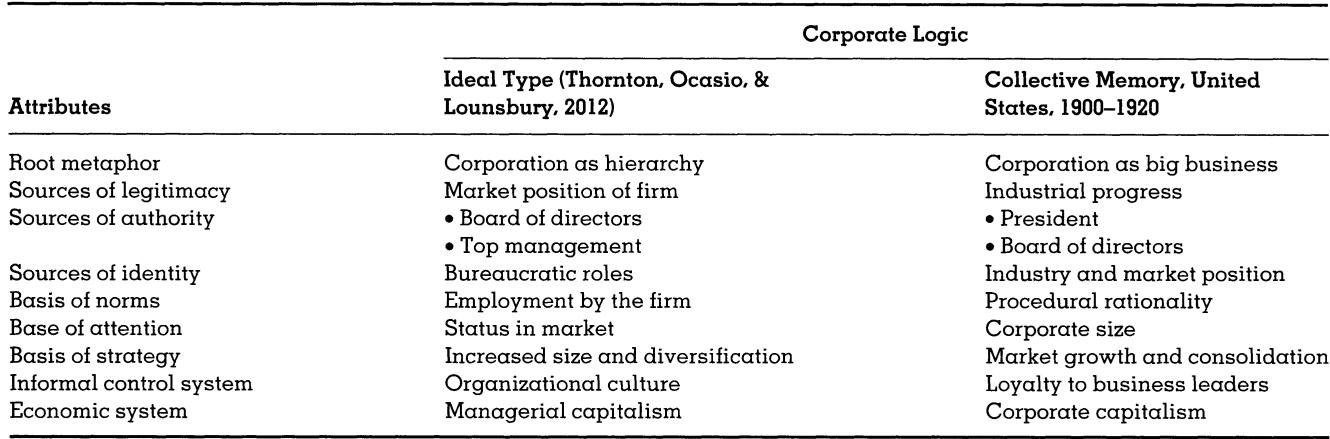
Over time, coherent and convergent metanarrations emerged to organize and theorize these events into a distinct and meaningful vision of large-scale industrial organization. Our reading of contemporaneous historical sources indicates that with the reelection of McKinley in 1900 and the creation of the U.S. Steel Corporation in 1901 (the largest corporation in American history at the time), a distinct corporate logic became institutionalized (albeit not uncontested). Following the great merger wave of 1893-1903, American businesses became larger and more influential than ever, further reinforcing the new logic. By the early twentieth century, the collective focus was on centralization of control through corporations, rather than extensive managerial hierarchies (Roy, 1997). The holding company emerged as the dominant organizational structure of the time. Moreover, the legitimacy of the corporation rested on its promise of industrial progress, rather than the market position of the firm.
Based on our reading of secondary historical accounts, in Table 3 we summarize the corporate logic as constituted through collective memory. By 1920 the history of big business had entered into collective memory (Hendrick, 1919; Moody, 1919), shaping contemporary understanding of the corporation and its organizing principles. Our characterization of the corporate logic differs from the transhistorical ideal type derived in prior theoretical work (Thornton, 2004), reinforcing our contention that a historical perspective on societal logics reveals variation that would otherwise remain hidden. The historical sources we draw on do not, of course, explicitly discuss the rise of the corporate logic and its principal dimensions. Additional historical research is needed to provide empirical validation and refinement of our claims. Nevertheless, viewing societal logics through the lens of history and collective memory does provide a substantially different perspective than does a focus on transhistorical ideal types (cf. Thornton et al., 2012).
Our example also illustrates the importance of archives in the formation of societal logics. Indeed, diverse sets of fields and archives were critical to the emergence of the corporate logic, including those housing court documents and case law, as well as influential fairs, expositions, and public museums. The public press constituted yet another source of documents that shaped the prevailing collective memory of the corporation. Financial archives played a key role as this process unfolded and ultimately emerged as an industry in its own right starting in the 1860s, leading to the formation of public accounting standards and the documentation of market valuations of large U.S. corporations. Together, such archives filtered, related, and propagated the historical events that ultimately defined and promoted the corporate logic and its eponymous organizations. In this sense our perspective departs from the more functionalist efficiency view of the corporation associated with Chandler (1977, 1990), highlighting instead the importance of institutions, culture, and politics in the corporatization of society (Lipartito & Sicilia, 2004).
TABLE 3 Comparison of Ideal-Typical and Historically Derived Models of the Corporate Logic
DISCONTINUITIES IN THE EVOLUTION OF SOCIETAL LOGICS
Thus far we have outlined a model for analyzing collective memory making and its role in the emergence and evolution of societal logics, illustrating our argument with the example of the corporate logic in the United States. We have sought to incorporate history into a theory of societal logics, moving beyond treatments of these logics as ideal types toward a framework that redefines them as historical configurations. The cyclical nature of our model might suggest a continuous, uninterrupted evolution of collective memory (Lippmann & Aldrich, 2014); however, historical discontinuities can and do disrupt this process (Suddaby et al., 20l4). Most discontinuities have little consequence, but over time they can accumulate to incite more dramatic crises and transformations in collective memory and societal logics (Mahoney & Thelen, 2007). Such ruptures inevitably alter the processes described in our model, and we therefore theorize about them with reference to our empirical illustration.
As highlighted by business historian Glenn Porter, “The late nineteenth century’s rapid centralization of capitalist institutions was an earthquake that shook the ground on which nearly all Americans stood” (2006: 2, citing social historian Stuart Blumin, 2000). But this transformation differed from an earthquake insofar as it unfolded over decades (Porter, 2006; Trachtenberg, 1982; Wiebe, 1967). In accounting for this, we propose a theory of change distinct from models of punctuated equilibrium, which emphasize long periods of institutional stability interrupted by crisis-induced change (Krasner, 1984; Tushman & Romanelli, 1985), in that we highlight the ongoing accumulation of historical events and their collective memory as mechanisms for societal transformation. This difference yields four important insights.
First, dramatic institutional change can occur without an exogenous shock or crisis, since smallscale occurrences contribute to the gradual reconfiguration of collective memory and societal logics. Second, major and transformative events may often take the form of opportunities rather than crises, and even crises may be widely perceived as opportunities. The status of an event as an opportunity or crisis, both at the time and in the future, depends on the trajectory of collective memory making. Third, crises should be understood more broadly than in much current theory as including some events that are not of immediate import. Of course, some major events, both opportunities and crises, do generate almost contemporaneous societal shifts (such as the Panic of 1893 or the completion of the Transcontinental Railroad). However, we posit that many crises emerge primarily through ongoing collective memory making, as emerging metanarratives position certain events as signs of social upheaval. This may take the form of a single event that is slowly “revealed” as a watershed moment, or it may occur when a number of different events are understood as signaling the same underlying problem or need for change (a confluence of events). In each case a disjuncture between past and present (and future) is rhetorically and symbolically effected—and a crisis is created. Fourth, the impact of a crisis may not be contemporaneous; rather, a crisis may be influential long after its constituent events are past.
This approach parallels the historical institutionalism in political science, which combines discontinuous causal chains with threshold effects and the accumulation of evolutionary change to explain complex historical transformations (Pierson, 2004: Schneiberg, 2007). However, our focus on collective memory departs from this perspective by granting greater import to the role of cultural change in historical transformation (Lipartito & Sicilia, 2004; Rowlinson & Hassard, 2014). Changes in the collective memory of historical events and of society more broadly generate historical discontinuities in contemporary cultural structures, including societal logics. While an exhaustive examination of these discontinuities is beyond the scope of this article, we identify and discuss two distinct forms: the confluence of events across institutional fields and changes to the communicative infrastructure.
Confluence of Events
One mechanism explaining historical changes in societal logics and their configuration is the confluence of historical events across fields and institutional orders, or a perceived shift in “what is happening” within a given society. As noted above, retrieval processes can lead to variations in ongoing interpretations of historical events and documents, while maintaining the guiding principles of societal logics. For these logics to change, events and their metanarratives must transcend individual fields in an apparent “phase shift.” Prior theory has highlighted event sequences as important drivers of change in fieldlevel logics (Thornton & Ocasio, 2008); however, these sequences require a direct connection between historical events. By emphasizing the confluence of events, we extend this view to include events that may not be directly connected to one another and that may occur across seemingly unrelated field and societal sectors.
We posit that a confluence of events will tend to generate historical discontinuities in existing metanarratives whenever these events are not readily represented by means of existing societal logics. Historical discontinuities, in the form of substantial ruptures in societal logics and their configurations, are generated through collective memory making, as old cultural distinctions are either challenged or disregarded on the basis of this confluence and new understandings are proposed and contested (see Glaeser, 20ll). Through this process, previous understandings of historical events and documents can be radically altered. Old documents may be transformed into anthropological material, providing insight into esoteric beliefs or errors of understanding rather than any “real” insight into the events in question (Glaeser, 2011; Zeitlyn, 2012). New documents and metanarratives may situate old events within novel plots, featuring different actors and themes (Schwartz, 2005). Ultimately, cumulative changes in metanarration will likely influence future occurrences, embedding significant and epochal transformations in societal logics.
In the case of the corporate logic, the confluence of events that led to its transformation was built on a loosely interconnected set of events that unfolded across the political, legal, financial, and community spheres. These events included the Sherman Antitrust Act of 1890, the Panic of 1893, the World’s Columbian Exposition of 1893-1894, the election of William McKinley in 1896 (and reelection in 1900), and the creation of the U.S. Steel Corporation in 190l. Over time, diverse interpretations of events in these various fields began to converge, leading to a perceived confluence of events and a recognizable discontinuity in society. In turn, this led to a more general change in metanarratives concerning the corporation and its role in the economy, politics, and society at large. The societal logic of the U.S. corporation, with the opportunities and threats it highlighted, emerged from and later reinforced the prevailing collective memory, as well as the metanarratives within which these events were situated. This logic then became a common framework for interpretation and action across multiple organizations and institutional fields.
Changes in the Communicative Infrastructure
Every aspect of our model is also dependent on the communicative infrastructure characterizing α particular society (cf. Bowker, 2008). By communicative infrastructure we mean the configuration of communication technologies, systems, networks, and practices that characterize a particular historical period—the general sociotechnological system through which individuals connect and communicate with each other. The presentation, storage, and retrieval of occurrences and historical events all depend on the circuits of communication in which individuals and groups are situated. In turn, these circuits of communication are enabled and shaped by sociomaterial technologies, such as books, pamphlets, telegraphs, telephones, mail systems, road and railroad systems, filing systems, computers, and the internet (Bowker, 2008; Chandler, 1977; Yates, 1989).
When considered collectively, communicative infrastructures serve as sources of historical discontinuities in logics and historical shifts in the process of collective memory making itself (Bowker, 2008). The communicative infrastructure furnishes the pathways by which representation and documentation occur, as well as shapes the number, nature, and effectiveness of the gatekeepers who seek to mold these processes. Thus, this infrastructure helps determine which occurrences emerge as noteworthy, which historical events are most frequently retrieved, and how the metanarration of events shapes collective memory (Olick, 1999). It also creates opportunities for individuals to make sense of and represent historical events, and influences the extent to which potential representations and documents are subsequently tested and elaborated through engagement with particular audiences. Communicative infrastructure affects storage as well, providing the technological and social design of repositories and the possibilities for more or less detailed classification and cataloguing within the archives. Finally, it affects retrieval by shaping the social and material ease of access to archives and the documents stored therein. Major transformations in the communicative infrastructure unavoidably influence the reproduction and transformation of societal logics, whether the shift in infrastructure takes the form of administrative reform (Bowker & Star, 2000; Espeland & Stevens, 2008; Scott, 1998), managerial innovations (Chandler, 1977; Yates, 1989), or technological innovations (Assmann, 2008; Bowker, 2008; Bowker, Baker, Millerand, & Ribes, 2009).
Bowker (2008) indicated that changes in communicative infrastructure create distinct epochs of memory wherein different forms of archives predominate (although he used different terminology). Different epochs of memory are shaped by different forms of archiving, including oral transmission, written transmission, the formation of formal libraries and monastery collections in the late Middle Ages, the printing press, file cards, mechanical writing, electronic sequencing, and most recently the internet. While Bowker explored the impact of these changes on memory in the sciences, shifts in archival practices also lead to discontinuities in the evolution of societal logics. For example, Beniger (l986) explored how changes in communicative technologies between 1840 and 1920 encouraged the emergence of an information society, which produced a number of new organizations devoted to communication technology and reconfigured the roles of certain societal logics in a manner similar to contemporary transformations in information technology (Castells, 2000).
DISCUSSION AND CONCLUSIONS
To summarize, we have developed a new framework to explain the historical constitution of societal logics. These logics define the fundamental forms of life that characterize a society, providing the basic organizing principles for religious or family life or for market transactions (for example). In prior work on societal logics, scholars have treated them primarily as ideal types—transhistorical generalizations of abstract principles that may apply across distinct societies and histories. Here we have developed an alternative approach, one that makes history and memory making central to the development and reproduction of societal logics. We have done so by positing collective memory as a critical, multistaged process through which logics emerge and evolve. By this means we seek both to make the institutional logics perspective more historically cognizant (Kipping & Üsdiken, 2014) and to increase its worth as a tool for analytically structured histories in organization studies and beyond (Rowlinson et al., 2014).
According to our theory, collective memory refers to both process and content: a process of representing, storing, and retrieving memories of occurrences and historical events and a specific set of memories documented and stored in archives. We posit that collective memory, rather than an aggregation of individual memories or a shared consensus (cf. Olick & Robbins, 1998), operates through material documents, which are stored in archives and shape the contours of historical events. Societal logics emerge and are reproduced through archives as metanarratives converge across fields and impose coherence on a wide range of documents and the occurrences and historical events they represent. Although convergent metanarratives do generate enduring cultural structures, our framework also accounts for the recursive reinterpretation of events through the retrieval process, as well as the potentially disruptive role of historical discontinuities in collective memory making, which can radically change both the content and configuration of societal logics.
Historicizing the Institutional Logics Perspective
We make three main contributions to the institutional logics perspective. First, we move away from a static conceptualization of societal logics. Rather than relying on transhistorical ideal types, we propose that societal logics should be understood as historically situated. Configurations of societal logics, along with the set of social domains they distinguish and their relative jurisdictions, reflect the dynamics of collective memory making. Thus, the status of the market or corporate logics as societal logics is not given but instead reflects a particular historical moment (and the histories told at that time). Furthermore, the principles and practices of any given societal logic are not fixed. Rather, these logics are subject to reconfiguration as the collective memory of historical events creates shifts in patterns of metanarration. Our model thus shows how societal logics emerge in their historical specificity.
Second, our theory contributes to the understanding of cross-level perspectives on institutional logics and the distinction between societal and field-level institutional logics. In particular, it reveals societal logics as thoroughly historical formations, shaped by lower-level occurrences and archives. Archives serve as a prism through which to view not only societal logics but also field-level institutions and organizations. Fieldlevel variations in vocabularies and associated archiving practices can generate changes in institutional logics at the field level, as well as interfield differentiation (Loewenstein et al., 2012; Ocasio, Loewenstein, & Nigam, 2015). Critically, however, this process is complemented by changes in the direct experiences of a field (Purdy & Gray, 2009; Seo & Creed, 2002). This stands in contrast with the formation of societal logics, where immediately shared experiences are likely to be few and far between. Societal logics cannot be explained through the aggregation of organizational- and field-level activities alone; instead, “shared” experiences are provided by historical events and metanarratives. More so than field logics, societal logics are crafted from history itself.
Third, we build theory on discontinuities in societal logics and the interinstitutional systems they constitute. The configuration and content of societal logics, and the degree of institutional complexity experienced by individuals and organizations within that society, are dependent on the contemporary communicative infrastructure, as well as confluences of historical events. The market, corporate, professional, community, state, and even family logics are all susceptible to transformation via historical discontinuities in communicative infrastructure. Similarly, they are susceptible to the creation of historical disjunctures or epochal shifts through collective memory making and the confluence of events. Our theory is thus not only a theoretical model of societal history but also a model cognizant of historical epochs and discontinuities (Kipping & Üsdiken, 2014).
Contributions to the Study of Collective Memory
Beyond introducing and developing the concept of collective memory to the study of societal logics, our theoretical framework highlights the role of archives in storing and organizing the content of collective memory and in constructing history. As semistructured repositories of knowledge concerning ongoing occurrences and historical events, archives provide the means by which collective memories can transcend individual minds. Participants do not need to rely on their own experience of society and its institutional orders but instead can draw on the documented experiences of others, past and present. Collective memory is not simply stored in these archives to remain inert and collect dust. Rather, these memories and their material representations are retrieved to reinforce or contest existing interpretations of historical documents and events, thereby enabling the cultural transmission of memories from one historical period to another.
The archives, embodied in collections of documents and structured by a cultural system of classification, generate a complex history of societal events. Our theory posits that archives help generate durable cultural structures, binding historical events together through metanarration. Metanarratives are emergent accomplishments of the archives, the historical development of which shapes the emergence and evolution of societal logics. One process that shapes the archives’ development is theorization, a phenomenon that has been highlighted previously in the context of field-level logics (Lok, 2010; Rao et al., 2003). We argue that theorization also operates at the level of society, with historians—both popular and professional-playing a key role in constructing theories of societies. Metanarratives may also be generated through more inductive processes—for example, via analogies and comparisons between stories of distinct historical events (Connor, 2012).
Implications for Organizations and Practice
Our focus on the historicity and contingency of societal logics provides us with a distinct lens to understand and study organizations and their practices. Here we highlight three implications in particular for the study of (1) organizational culture and strategy, (2) entrepreneurship, and (3) the evolution of fields and organizational ecologies.
Consistent with prior theory and research, we view societal logics as providing general principles that reflective actors can use to create, maintain, or disrupt organizational- and fieldlevel arrangements, or to guide action when local logics fail. When the collective memory making that constitutes societal logics shifts, so, too, do the principles and values that underlie organizational cultures and strategies. Our model thus points to the importance of historical disjunctures in collective memory making, which are likely both to influence the shaping of subsequent organizations and to reshape extant organizational cultures and practices. Our theory also points to the importance of collective memory in mediating the influence of societal logics. These logics shape the ease with which different historical events and exemplars can be retrieved as relevant guides for individuals and organizations, thus influencing the framing contests through which strategy making is achieved (Kaplan, 2008), as well as the formation of organizational culture and identity (Gioia, Patvardhan, Hamilton, & Corley, 2013). In everyday circumstances this may well be the primary mechanism of influence for societal logics.
Societal logics also shape opportunities for entrepreneurship. Collective memories provide sources of inspiration for individual entrepreneurs, just as memories of the U.S. Civil War encouraged entrepreneurial investment in corporations and large-scale industry. These memories provide sources of variation in organizational behavior, and drawing on collective memories can also serve as a resource as entrepreneurs attempt to make their innovations acceptable and legitimate (see Lounsbury & Glynn, 2001).
Historical shifts in societal logics also influence field-level changes, shaping the organizational forms and practices considered legitimate within particular fields or industries and, thus, the evolution of organizational and professional ecologies. For example, as the societal logic of the corporation has shifted, so, too, has the role and nature ofcorporate governance. The earlytwentieth-century corporation had significant concentration of ownership, with boards of directors and financial owners still having substantial power. After the 1920s, the corporate logic began to change, with separation of ownership and control being increasingly emphasized and managerial power waxing relative to that of owners (Berle & Means, 1967). By the 1980s, a significant countermovement was under way as the rhetoric and practices of shareholder value gained substantial influence within corporations (Fligstein, 2002). The collective memory of the corporation in the late twentieth and early twentyfirst century is no longer dominated by stories emphasizing steep managerial hierarchies; the focus instead is on responsiveness to financial markets (Davis, 2009). In each period societal norms of appropriate corporate form and behavior have shaped organizational activities across a variety of industries and fields.
These historical shifts have a concrete influence on a variety of key empirical relationships and variables in organizational analysis. Shifts in the relative influence of logics shape the dynamics of corporate governance at both the field and organizational levels, including the relative power of owners and executives (Joseph, Ocasio, & McDonnell, 2014). Historical discontinuities also shift the selection environments of organizations such that organizations that are more congruent with shifting societal logics will be more likely to persist, whereas those that remain tied to oldform logics will be less likely to survive and flourish. Thus, historical shifts in societal logics not only drive shifts in organizational strategy making and patterns of entrepreneurship but also influence rates of organizational survival.
Concluding Remarks
Understanding historical changes to institutional logics through collective memory making has important implications for empirical research as well as theory, both in the social sciences and in history. Textual and other forms of content analysis now constitute a well-established set of methods for studying institutional logics and their effects. Although extant research focuses on fieldlevel logics (Jones, Maoret, Massa, & Svegenova, 2012; Weber, Patel, & Heinze, 2013), our theory suggests that archival documents can also serve as an important source for examining societal logics and their effects, and that archives are an important site for research into their ongoing constitution. In addition to encouraging the engagement of the logics perspective with history and the analysis of collective memory, our theory points to the importance of communicative infrastructures. We have suggested that changes to these infrastructures have redefined the boundaries of societal institutions, and our understandings of those institutions, by increasing the openness of collective memory making and the accessibility of collective memory. Organizational scholars should continue to take advantage of these new sources of data to study this shift in infrastructure and its consequences for societal logics and their (re)configurations.
Our emphasis on collective memory further suggests the importance of empirically examining not only the storage of current events in archives but also changes in the interpretation of historical events (Schwartz, 1996, 2000). Widespread changes in the collective memory of past events may serve as a critical indicator of shifting metanarratives and, by proxy, the emergence, transformation, or reconfiguration of institutional logics. Similarly, our approach suggests that when examining representations and documentations of current societal events, focusing on the selective retrieval of analogies from the past may help us understand and measure how societal logics evolve. Future research might employ our model to study variations in patterns of retrieval and sensemaking over time.
Finally, our historical approach to the formation of societal logics and institutions provides a new perspective on the study of history itself. We argue that as logics change, histories of past events change as well, reflecting new configurations of societal logics that shape understandings of the past, present, and future. Historians and social scientists alike can build on these insights to develop new measures and strategies to study history, empowering them to systematically track how the emergence and interpretation of events relate to the evolution and transformation of institutions, logics, and archives.
REFERENCES
Adams, H. 193l. (First published in 1917.) The education of Henry Adams. New York: Modern Library.
Anderson, B. 1983. Imagined communities: Reflections on the origin and spread of nationalism. New York: Verso.
Anteby, M., & Molnár, V. 2012. Collective memory meets organizational identity: Remembering to forget in a firm’s rhetorical history. Academy of Management Journal, 55: 515540.
Assmann, A. 2008. Canon and archive. In A. Erll & A. Nünning (Eds.), Cultural memory studies: An international and interdisciplinary handbook: 97-108. Berlin: Walter de Gruyter.
Battilana, J., & Dorado, S. 2010. Building sustainable hybrid organizations: The case of commercial microfinance organizations. Academy of Management Journal, 53: 14191440.
Beniger, J. R. 1986. The control revolution. Cambridge, MA: Harvard University Press.
Berger, P., & Luckmann, T. 1967. The social construction of reality: A treatise in the sociology of knowledge. London: Penguin.
Berle, A. A., & Means, G. C. 1967. The modern corporation and private property (2nd ed.). New York: Harcourt, Brace and World.
Blumin, S. M. 2000. The social implications of U.S. economic development. In S. L. Engerman & R. E. Gallman (Eds.), The Cambridge economic history of the United States. bridge: Cambridge University Press.
Boje, D. M. 2008. Storytelling organizations. Thousand Oaks, CA: Sage.
Booth, C., & Rowlinson, M. 2006. Management and organizational history: Prospects. Management & Organizational History, 1: 530.
Bowker, G. C. 2008. Memory practices in the sciences. Cambridge, MA: MIT Press.
Bowker, G. C., Baker, K., Millerand, F., & Ribes, D. 2009. Toward information infrastructure studies: Ways of knowing in a networked environment. In J. Hunsinger, L. Klastrup, & M. Allen (Eds.), International handbook of internet research: 97-117. London: Springer.
Bowker, G. C., & Star, S. L. 2000. Sorting things out: Classification and its consequences. Cambridge, MA: MIT Press.
Brewer, M. B. 199l. The social self: On being the same and different at the same time. Personality and Social Psychology Bulletin, 17: 475482.
Briet, S. 2006. (First published in 1951.) What is documentation? English translation of the classic French text. (Translated and edited by R. E. Day & L. Martinet, with H. G. B. Anghelescu.) Lanham, MD: Scarecrow Press.
Bucheli, M., & Wadhwani, R. D. 2014. Organizations in time: History, theory, methods. Oxford: Oxford University Press.
Buckland, M. K. 1991l. Information as thing. Journal of the American Society for Information Science, 42: 351-360.
Casey, A. 1997. Collective memory in organizations. Organizational Learning and Strategic Management: Advances in Strategic Management, 14: 111-151.
Casey, A. J., & Olivera, F. 2011. Reflections on organizational memory and forgetting. Journal of Management Inquiry, 20: 305310.
Castells, M. 2000. The rise of the network society: The information age: Economy, society, and culture, Volume l. Malden, MA: Wiley-Blackwell.
Caswell, M. 2010. Khmer Rouge archives: Accountability, truth, and memory in Cambodia. Archival Science, 10: 2544.
Chandler, A. D., Jr. 1977. The visible hand: The managerial revolution in American business. Cambridge, MA: Belknap Press of Harvard University Press.
Chandler, A. D., Jr. 1990. Scale and scope: The dynamics of industrial capitalism. Cambridge, MA: Belknap Press of Harvard University Press.
Chia, R. 2000. Discourse analysis as organizational analysis. Organization, 7: 513518.
Clark, P., & Rowlinson, M. 2004. The treatment of history in organisation studies: Towards an “historic turn”? Business History, 46: 331352.
Coleman, J. S. 1992. The assymmetric society. Syracuse, NY: Syracuse University Press.
Connor, B. T. 2012. From analogy to metanarrative: Meanings of $\mathfrak { s } / 1 1$ in civil society. Cultural Sociology, 6: 325.
Cook, T. 2007. Remembering the future: Appraisal of records and the role of archives in constructing social memory. In F. X. Blouin, Jr., & W. G. Rosenberg (Eds.), Archives, documentation, and institutions of social memory: Essays from the Sawyer Seminar 2007: 169-181. Ann Arbor: University of Michigan Press.
Creed, W. E. D., DeJordy, R., & Lok, J. 2010. Being the change: Resolving institutional contradiction through identity work. Academy of Management Journal, 53: 13361364.
Cronon, W. 1992. Nature’s metropolis: Chicago and the Great West. New York: Norton.
Cuc, A., Ozuru, Y., Manier, D., & Hirst, W. 2006. On the formation of collective memories: The role of a dominant narrator. Memory & Cognition, 34: 752762.
Daft, R., & Weick, K. 1984. Toward a model of organizations as interpretation systems. Academy of Management Review, 9: 284295.
Davis, G. F. 2009. Managed by the markets: How finance reshaped America. Oxford: Oxford University Press.
De Vivo, F. 2010. Ordering the archive in early modern Venice (14001650). Archival Science, 10: 231248.
Dunn, M. B., & Jones, C. 2010. Institutional logics and institutional pluralism: The contestation of care and science logics in medical education, 1967-2005. Administrative Science Quarterly, 55: 114149.
Durkheim, E. 1964. The division of labor in society. New York: Free Press.
Espeland, W. N., & Stevens, M. L. 2008. A sociology of quantification. European Journal of Sociology, 49: 401436.
Fine, G. A. 1997. Scandal, social conditions, and the creation of public attention: Fatty Arbuckle and the “Problem of Hollywood.” Social Problems, 44: 297323.
Fine, G. A. 2007. The construction of historical equivalence: Weighing the Red and Brown Scares. Symbolic Interaction, 30: 2739.
Fin G. A. &Beim, A.2007. Introuctin: Intactionist proaches to collective memory. Symbolic Interaction, 30: 15.
Fligstein, N. 2002. The architecture of markets: An economic sociology of twenty-first-century capitalist societies. Princeton, NJ: Princeton University Press.
Foucault, M. 2002. The archeology of knowledge. London: Routledge Classics.
Friedland, R., & Alford, R. R. 1991. Bringing society back in: Symbols, practices and institutional contradictions. In W. W. Powell & P. J. DiMaggio (Eds.), The new institutionalism in organizational analysis: 232263. Chicago: University of Chicago Press.
Garfinkel, H. 1967. Studies in ethnomethodology. Cambridge: Polity Press.
Gawer, A., & Phillips, N. 2013. Institutional work as logics shift: The case of Intel’s transformation to platform leader. Organization Studies, 34: 10351071.
Gedi, N., & Elam, Y. 1996. Collective memory—What is it? History & Memory, 8: 3050. Gioia, D. A., Patvardhan, S. D., Hamilton, A. L., & Corley, K. G. 2013. Organizational identity formation and change. Academy of Management Annals, 7: 123-192.
Glaeser, A. 20ll. Political epistemics: The secret police, the opposition, and the end of East German socialism. Chicago: University of Chicago Press.
Glynn, M. A. 2000. When cymbals become symbols: Conflict over organizational identity within a symphony orchestra. Organization Science, 11: 285298.
Goodrick, E., & Reay, T. 20ll. Constellations of institutional logics: Changes in the professional work of pharmacists. Work and Occupations, 38: 372416.
Greenwood, A., & Bernardi, A. 2014. Understanding the rift, the (still) uneasy bedfellows of history and organization studies. Organization, 21: 907932.
Greenwood, R., Raynard, M., Kodeih, F., Micelotta, E. R., & Lounsbury, M. 201l. Institutional complexity and organizational responses. Academy of Management Annals, 5: 317371.
Halbwachs, M. 1992. On collective memory. (Edited by L. A. Coser.) Chicago: University of Chicago Press.
Hatch, M. J. 1993. The dynamics of organizational culture. Academy of Management Review, 18: 657693.
Hatch, M. J., & Zilber, T. 2012. Conversation at the border between organizational culture theory and institutional theory. Journal of Management Inquiry, 21: 9497.
Haveman, H., & Rao, H. 1997. Structuring a theory of moral sentiments: Institutional and organizational coevolution in the early thrift industry. American Journal of Sociology, 102: 16061651.
Hendrick, B. J. 1919. The age of big business. New Haven, CT: Yale University Press.
Hilgartner, S., & Bosk, C. L. 1988. The rise and fall of social problems: A public arenas model. American Journal of Sociology, 94: 5378.
Hoffman, A. J., & Ocasio, W. 2001. Not all events are attended to equally: Toward a middle-range theory of industry attention to external events. Organization Science, 12: 414434.
Jones, C., Maoret, M., Massa, F. G., & Svegenova, S. 2012. Rebels with a cause: Formation, contestation, and expansion of the de novo category “modern architecture,” 18701975. Organization Science, 23: 15231545.
Joseph, J., Ocasio, W., & McDonnell, M.-H. 2014. The structural elaboration of board independence: Executive power, institutional logics, and the adoption of CEO-only board structures in U.S. corporate governance. Academy of Management Journal, 57: 18341858.
Kahneman, D. 201l. Thinking, fast and slow. New York: Farrar, Straus and Giroux.
Kaplan, S. 2008. Framing contests: Strategy making under uncertainty. Organization Science, 19: 729752.
Keiser, A. 1994. Crossroads: Why organization theory needs historical analysis, and how this should be performed. Organization Science, 5: 608620.
Kellogg, K. C. 2011. Challenging operations: Medical reform and resistance in surgery. Chicago: University of Chicago Press.
Kipping, M., & Üsdiken, B. 2014. History in organization and management theory: More than meets the eye. Academy of Management Annals, 8: 535588.
Kitchener, M. 2002. Mobilizing the logic of managerialism in professional fields: The case of academic health centre mergers. Organization Studies, 23: 391420.
Kraatz, M. S. 2009. Leadership as institutinal work: A bridge to the other side. In T. B. Lawrence, R. Suddaby, & B. Leca (Eds.), Institutional work: Actors and agency in institutional studies of organizations: 59-9l. Cambridge: Cambridge University Press.
Krasner, S. D. 1984. Approaches to the state: Alternative conceptions and historical dynamics. Comparative Politics, 16: 223246.
Lawrence, T. B., Suddaby, R., & Leca, B. (Eds.). 2009. Institutional work: Actors and agency in institutional studies of organizations. Cambridge: Cambridge University Press.
Lo, K. &Sicilia, D. B.Eds.. 200.Cnucor America: History, politics, culture. New York: Oxford University Press.
Lippmann, S. & Aldrich, H. E. 2014. History and evolutionary theory. In M. Bucheli & R. D. Wadhwani (Eds.), Organizations in time: History, theory, methods: 124146. Oxford: Oxford University Press.
Loewenstein, J., Ocasio, W., & Jones, C. 2012. Vocabularies and vocabulary structure: A new approach to linking categories, practices, and onstitutions. Academy of Management Annals, 6: 4186.
Lok, J. 2010. Institutional logics as identity projects. Academy of Management Journal, 53: 13051335.
Lounsbury, M., & Glynn, M. A. 200l. Cultural entrepreneurship: Stories, legitimacy, and the acquisition of resources. Strategic Management Journal, 22: 545564.
Lukes, S. 2005. Power: A radical view (2nd ed.). New York: Palgrave Macmillan.
Lund, N. W. 2009. Document theory. Annual Review of Information Science and Technology, 43: 155.
Maguire, S., & Hardy, C. 2009. Discourse and deinstitutionalization: The decline of DDT. Academy of Management Journal, 52: 148178.
Mahoney, J. & Thelen, K. (Eds.). 2007. Explaining institutional change: Ambiguity, agency, and power. Cambridge: Cambridge University Press.
Manoff, M. 2004. Theories of the archive from across the disciplines. Libraries and the Academy, 4: 925.
Moody, J. 1919. The railroad builders: A chronicle of the welding of the states. New Haven, CT: Yale University Press.
Murray, F. 2010. The oncomouse that roared: Hybrid exchange strategies as a source of distinction at the boundary of overlapping institutions. American Journal of Sociology, 116: 341388.
Nissley, N., & Casey, A. 2002. The politics of the exhibition: Viewing corporate museums through the paradigmatic lens of organizational memory. British Journal of Management, 13(S2): 3545.
Ocasio, W. 1997. Towards an attention-based view of the firm. Strategic Management Journal, 18(S1): 187206.
Ocasio, W., Loewenstein, J., & Nigam, A. 2015. How streams of communication reproduce and change institutional logics: The role of categories. Academy of Management Review, 40: 2848.
Olick, J. K. 1999. Collective memory: The two cultures. Sociological Theory, 17: 333348.
Olick, J. K. 2007. The politics of regret: On collective memory and historical responsibility. London: Routledge.
Olick, J. K., & Robbins, J. 1998. Social memory studies: From “collective memory” to the historical sociology of mnemonic practices. Annual Review of Sociology. 24: 105140.
Olick, J. K., Vinitzky-Seroussi, V., & Levy, D. (Eds.). 201l. The collective memory reader. New York: Oxford University Press.
Olsen, B. I., Lund, N. W., Ellingsen, G., & Hartvigsen, G. 2012. Document theory for the design of socio-technical systems: A document model as ontology of human expression. Journal of Documentation, 68: 100-126.
Pierson, P. 2004. Politics in time: History, institutions, and social analysis. Princeton, NJ: Princeton University Press.
Polanyi, K. 1944. The great transformation: Economic and political origins of our time. New York: Rinehart.
Porter, G. 2006. The rise of big business, 1860-1920 (3rd ed.). Hoboken, NJ: Wiley-Blackwell.
Pouthier, V., Steele, C. W. J., & Ocasio, W. 2013. From agents to principles: The relationship between hospitalist identity and logics of healthcare. Institutional Logics in Action: Research in the Sociology of Organizations, 39: 203241.
Purdy, J. M., & Gray, B. 2009. Conflicting logics, mechanisms of diffusion, and multilevel dynamics in emerging fields. Academy of Management Journal, 52: 355380.
Rao, H., Monin, P., & Durand, R. 2003. Institutional change in Toque Ville: Nouvelle cuisine as an identity movement in French gastronomy. American Journal of Sociology, 108: 795843.
Rowlinson, M., Booth, C., Clark, P., Delahaye, A., & Procter, S. 2010. Social remembering and organizational memory. Organization Studies, 31: 6987.
Rowlinson, M., & Hassard, J. 2014. History and the cultural turn in organization studies. In M. Bucheli & R. D. Wadhwani (Eds.), Organizations in time: History, theory, methods: 147165. Oxford: Oxford University Press.
Rowlinson, M., Hassard, J., & Decker, S. 2014. Research strategies for organizational history: A dialogue between historical theory and organization theory. Academy of Management Review, 39: 250274.
Roy, W. G. 1997. Socializing capital: The rise of the large industrial corporation in America. Princeton, NJ: Princeton University Press.
Saxer, D. 2010. Archival objects in motion: Historians’ appropriation of sources in nineteenth-century Austria and Switzerland. Archival Science, 10: 315331.
Schneiberg, M. 2007. What’s on the path? Path dependence, organizational diversity and the problem of institutional change in the U.S. economy, 1900-1950. Socio-Economic Review, 5: 4780.
Schudson, M. 1989. How culture works: Perspectives from media studies on the efficacy of symbols. Theory and Society, 18: 153180.
Schultz, M. 2012. Relationships between institutional logics and organizational culture. Journal of Management Inquiry, 21: 102106.
Schwartz, B. 1996. Memory as a cultural system: Abraham Lincoln in World War II. American Sociological Review, 61: 908927.
Schwartz, B. 2000. Abraham Lincoln and the forge of American memory. Chicago: University of Chicago Press.
Schwartz, B. 2005. The New Gettysburg Address: Fusing history and memory. Poetics, 33: 6379.
Schwartz, B., & Kim, M. 2002. Honor, dignity and collective memory. In K. Cerulo (Ed.), Culture in mind: 209-226. London: Routledge.
Schwartz, J. M., & Cook, T. 2002. Archives, records, and power: The making of modern memory. Archival Science, 2: 119.
Scott, J. C. 1998. Seeing like a state: How certain schemes to improve the human condition have failed. New Haven, CT: Yale University Press.
Scott, W. R., Ruef, M., Mendel, P. J., & Caronna, C. A. 2000. Institutional change and healthcare organizations: From professional dominance to managed care. Chicago: University of Chicago Press.
Seo, M.-G., & Creed, D. W. 2002. Instutional contradicitions, praxis, and institutional change: A dialectical perspective. Academy of Management Review, 27: 222247.
Sewell, W., Jr. 2005. Logics of history: Social theory and social transformation. Chicago: University of Chicago Press.
Sklar, M. J. 1988. The corporate reconstruction of American capitalism, 1890-1916: The market, the law, and politics. Cambridge, MA: Cambridge University Press.
Smith, T. B. 2006. The untold story of Shiloh: The battle and the battlefield. Knoxville: University of Tennessee Press.
Stoler, A. L. 2002. Colonial archives and the arts of governance. Archival Science, 2: 87-109.
Suddaby, R., Foster, W. M., & Mills, A. J. 2014. Historical institutionalism. In M. Bucheli, & R. D. Wadhwani (Eds.), Organizations in time: History, theory, methods: 100123. Oxford: Oxford University Press.
Suddaby, R., & Greenwood, R. 2005. Rhetorical strategies of legitimacy. Administrative Science Quarterly, 50: 3567.
Taylor, G. R. 2015. The transportation revolution, 1815-1860. London: Routledge.
Taylor, G. R., & Neu, I. D. 1956. The American railroad network, 1861-1890. Champaign-Urbana: University of Illinois Press.
Thelen, K. 1999. Historical institutionalism in comparative politics. Annual Review of Political Science, 2: 369-404.
Thornton, P. H. 2004. Markets from culture: Institutional logics and organizational decisions in higher education publishing. Stanford, CA: Stanford University Press.
Thornton, P. H., & Ocasio, W. 1999. Institutional logics and the historical contingency of power in organizations:
Executive succession in the higher education publishing industry, 19581990. American Journal of Sociology, 105: 801843.
Thornton, P. H., & Ocasio, W. 2008. Institutional logics. In R. Greenwood, C. Oliver, & R. Suddaby (Eds.), Handbook of organizational institutionalism: 99-128. Thousand Oaks, CA: Sage.
Thornton, P. H., Ocasio, W., & Lounsbury, M. 2012. The institutional logics perspective: A new approach to culture, structure, and process. New York: Oxford University Press.
Trace, C. B. 2002. What is recorded is never simply “what happened”: Record keeping in modern organizational culture. Archival Science, 2: 137159.
Tracey, P., Phillips, N., & Jarvis, O. 2011. Bridging institutional entrepreneurship and the creation of new organizational forms: A multilevel model. Organization Science, 22: 60-80.
Trachtenberg, A. 1982. The incorporation of America: Culture and society in the Gilded Age. New York: Hill and Wang.
Tsoukas, H. 2005. Complex knowledge: Studies in organizational epistemology. Oxford: Oxford University Press.
Tushman, M. L., & Romanelli, E. 1985. Organizational evolution: Interactions between external and emergent processes and strategic choice. Research in Organizational Behavior, 8: 171222.
Walsh, J., & Ungson, G. R. 1991. Organizational memory. Academy of Management Review, 16: 5791.
Weber, K., Patel, H., & Heinze, K. L. 2013. From cultural repertoires to institutional logics: A content-analytic method. Institutional Logics in Action: Research in the Sociology of Organizations, 39: 351382.
Weick, K. 1995. Sensemaking in organizations. London: Sage.
Weick, K. E., & Roberts, K. 1993. Collective mind in organizations: Heedful interrelating on flight decks. Administrative Science Quarterly, 38: 357381.
Weick, K. E., Sutcliffe, K. M., & Obstfeld, D. 2005. Organizing and the process of sensemaking. Organization Science, 16: 409421.
Wenger, E. 1998. Communities of practice: Learning, meaning, and identity. Cambridge: Cambridge University Press.
White, H. 1973. Metahistory: The historical imagination in nineteenth-century Europe. Baltimore: Johns Hopkins University Press.
White, H. 2010. The fiction of narrative: Essays on history, literature, and theory, 1957-2007. (Edited by R. Doran.) Baltimore: John Hopkins University Press.
Wiebe, R. H. 1967. The search for order, 1877-1920. New York: Hill and Wang.
Wry, T., Cobb, J. A., & Aldrich, H. E. 2013. More than a metaphor: Assessing the historical legacy of resource dependence and its contemporary promise as a theory of environmental complexity. Academy of Management Annals, 7: 439486.
Yates, J. 1989. Control through communication: The rise of system in American firms. Baltimore: John Hopkins University Press.
Zald, M. N. 1993. Organization studies as a scientific and humanistic enterprise: Toward a reconceptualization of the foundations of the field. Organization Science, 4: 513528.
Zeitlyn, D. 2012. Anthropology in and of the archives: Possible futures and contingent pasts. Archives as anthropological surrogates. Annual Review of Anthropology, 41: 461480.
Zerubavel, E. 1996. Social memories: Steps towards a sociology of the past. Qualitative Sociology, 19: 283299.
Zilber, T. B. 2007. Stories and the discursive dynamics of institutional entrepreneurship: The case of Israeli high-tech after the bubble. Organization Studies, 28: 10351054.
Zilber, T. B. 2012. The relevance of institutional theory for the study of organizational culture. Journal of Management Inquiry, 21: 8893.
William Ocasio (wocasio@kellogg.northwestern.edu) is the John L. and Helen Kellogg Professor of Management and Organizations at the Kellogg School of Management, Northwestern University. He received his Ph.D. from Stanford University. His current research interests include institutional logics, managerial and organizational attention, power in organizations, and the role of vocabularies in organizations and institutions.
Michael Mauskapf (m-mauskapf@kellogg.northwestern.edu) is α doctoral candidate in management and organizations at Northwestern University, and holds a Ph.D. in musicology from the University of Michigan. His research interests include innovation in cultural markets, institutional complexity in the nonprofit sector, and the nexus between history and organizational change.
Christopher W. J. Steele (csteelel@ualberta.ca) is assistant professor of strategic management and organization at the University of Alberta and did his doctoral work at the Kellogg School of Management, Northwestern University. His research interests include the dynamics of institutions and practices, the formation of collective intentionality and identity, and the processes of knowledge production and consumption.